Webhooks
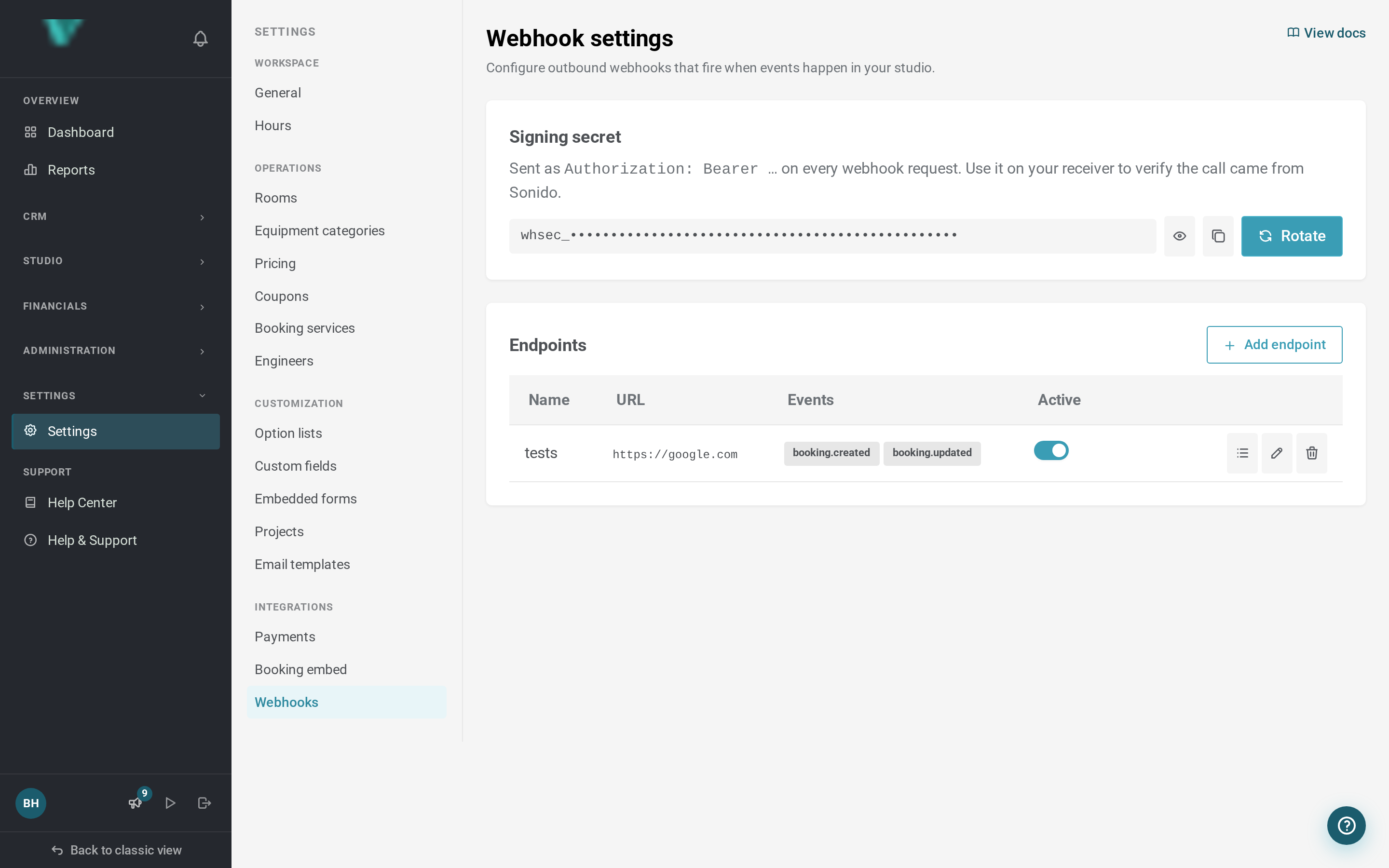
Webhooks let you subscribe to events inside Sonido and have them pushed to any HTTPS endpoint you control. Use them to sync bookings/projects into external systems, trigger automations in Zapier, or keep a CRM in step with studio activity without polling our API.
1. Concepts
- Endpoint — an external URL that will receive POSTs from Sonido. Each workspace can register multiple endpoints.
- Subscription — the set of event types a single endpoint listens for. An endpoint only receives events it is subscribed to.
- Signing secret — one secret per workspace. It is included on every outbound request so your receiver can confirm the call came from Sonido.
- Delivery — one row is recorded per HTTP attempt (including retries), viewable under the endpoint's deliveries log.
Managed at Settings → Webhooks (/v2/settings/webhooks).
2. Event catalog
Initial scope — more will be added as needed. Each event fires once per model lifecycle transition.
| Event | When it fires |
|---|---|
booking.created |
A new Booking is persisted |
booking.updated |
An existing Booking is saved |
booking.deleted |
A Booking is soft- or hard-deleted |
project.created |
A new Project is persisted |
project.updated |
An existing Project is saved |
project.deleted |
A Project is soft- or hard-deleted |
3. Request shape
Every delivery is a POST with a JSON body and the following headers:
Content-Type: application/json
Authorization: Bearer <workspace signing secret>
User-Agent: Sonido-Webhooks/1.0
X-Sonido-Event: booking.created
X-Sonido-Event-Id: evt_<24 random chars>
X-Sonido-Delivery-Attempt: 1
The body is a uniform envelope:
{
  "id": "evt_5fE7nGqJ8xZ3yU2wV1tBcKhD",
  "type": "booking.created",
  "timestamp": 1713370210,
  "data": {
    "object": { ... }
  }
}
id— globally unique event id. Use it for idempotency on your side.type— one of the values in the event catalog.timestamp— Unix timestamp (seconds) the event was emitted.data.object— the resource payload. Shape depends on the event's model (see below).
4. Payload — data.object
Booking (booking.*)
{
  "id": 1842,
  "title": "Mixdown session",
  "type": "session",
  "start_at": "2026-04-18T14:00:00-04:00",
  "end_at": "2026-04-18T18:00:00-04:00",
  "all_day": false,
  "is_pending": false,
  "is_recurring": false,
  "description": "Final mix pass on LP2",
  "event_type_id": 3,
  "invoice_id": null,
  "room": {
    "id": 4,
    "name": "Studio A",
    "color": "#c24e2a"
  },
  "created_by": {
    "id": 22,
    "first_name": "Jamie",
    "last_name": "Liu",
    "email": "jamie@example.com"
  },
  "assigned_users": [
    {
      "id": 12,
      "first_name": "Alex",
      "last_name": "Park",
      "email": "alex@example.com",
      "role_id": 3,
      "role_name": "Engineer"
    }
  ],
  "associated_entity": {
    "id": 87,
    "type": "App\\Models\\Band",
    "label": "The Midnight Drifters",
    "email": null,
    "contacts": [
      {
        "id": 140,
        "first_name": "Morgan",
        "last_name": "Reyes",
        "email": "morgan@example.com",
        "role": "primary"
      },
      {
        "id": 141,
        "first_name": "Sam",
        "last_name": "Okafor",
        "email": "sam@example.com",
        "role": "member"
      }
    ]
  },
  "guests": [
    {
      "name": "Taylor Brooks",
      "email": "taylor@example.com",
      "is_contact": true,
      "contact_id": 512
    },
    {
      "name": null,
      "email": "producer@label.com",
      "is_contact": false,
      "contact_id": null
    }
  ],
  "created_at": "2026-04-15T09:22:11-04:00",
  "updated_at": "2026-04-17T16:08:44-04:00"
}
Notes:
created_byreflects the studio user who owns the booking record.assigned_usersis the live list of studio users attached via the booking_users pivot, each with their role id + human-readable role name. These are staff (engineers, producers), not the client.associated_entityis the customer side of the booking: the Contact, Company, Band, Project, or Lead the session is for.typeis the fully-qualified PHP class of the morph target.labelis a pre-formatted display string. Use it if you just need something to show to a user.emailis the entity's own direct email when it has one (Contact, Company), otherwisenull.contactsis the flat list of people reachable through that entity, each with an email (which may benull) and arole. This is where the artists and bookers live, so an integration can set them up on its own side.roleis one ofcontact(the entity is itself a Contact),primary(the entity's primary contact),member(a band member), oremployee(a company employee). The list is deduplicated by contact, and excludes studio staff (seeassigned_users/created_byfor those). It is empty when the entity has no linked people.
guestslists everyone invited to the booking on the guest list, separate from the customer entity above.is_contactis true when the guest is a saved contact (withcontact_idset); it is false for an ad-hoc email typed straight onto the booking, wherecontact_idis null andnameis null when no real name was given. Use it to reach attendees who are neither studio staff nor the booking's primary customer.
Project (project.*)
{
  "id": 314,
  "name": "LP2 Pre-production",
  "type": "album",
  "stage": "tracking",
  "stage_id": 2,
  "start_date": "2026-04-20",
  "due_date": "2026-06-30",
  "band": { "id": 87, "name": "The Midnight Drifters" },
  "primary_contact": {
    "id": 140,
    "first_name": "Morgan",
    "last_name": "Reyes",
    "email": "morgan@example.com"
  },
  "company": { "id": 9, "name": "Drifters Records" },
  "created_at": "2026-04-10T11:00:00-04:00",
  "updated_at": "2026-04-17T12:33:00-04:00"
}
Any of band, primary_contact, company can be null when the
foreign key is not set.
5. Verifying the request
The tenant-level signing secret is sent on every delivery:
Authorization: Bearer whsec_<48 random chars>
Reject any request whose Authorization header does not match the secret you rotated into your app (use a constant-time comparison).
Example — Node/Express:
app.post('/sonido-webhook', express.json(), (req, res) => {
  const provided = (req.headers.authorization || '').replace(/^Bearer /, '');
  const expected = process.env.SONIDO_WEBHOOK_SECRET;
  const ok = provided.length === expected.length &&
    crypto.timingSafeEqual(Buffer.from(provided), Buffer.from(expected));
  if (!ok) return res.sendStatus(401);

  const event = req.body;            // { id, type, timestamp, data }
  // handle event.type ...
  res.sendStatus(204);
});
Example — PHP:
$provided = preg_replace('/^Bearer /', '', $request->header('Authorization', ''));
$expected = env('SONIDO_WEBHOOK_SECRET');
if (! hash_equals($expected, $provided)) {
    abort(401);
}
$event = $request->json()->all();
// handle $event['type'] ...
return response()->noContent();
If you rotate the secret in Settings → Webhooks, redeploy any receiver that stores it before rotating — existing integrations will start seeing 401s until the new value is in place.
6. Retries
A delivery is considered successful when your endpoint returns a 2xx
response within 5 seconds. Any other outcome (non-2xx, timeout, connection
error) is treated as a failure and retried.
| Attempt | Delay after previous failure |
|---|---|
| 1 | — (initial send) |
| 2 | 1 minute |
| 3 | 10 minutes |
| 4 | 15 minutes |
After four failed attempts the event is dropped. It is visible in the endpoint's deliveries log and can be manually redelivered from the UI or the API.
Design your receiver to be idempotent. Use id from the envelope as a
unique key — a retry carries the same id, so duplicate processing is
safe to reject. The X-Sonido-Delivery-Attempt header tells you which
attempt this is (1 = first send, ≥2 = retry).